
📘 “Ritu’s Phone”
(Blossom Class 3 – Pages 74–75)
—
Transactional Plan Format
Grade: 3
Month:
Subject: English
Week:
Lesson No.:
Lesson: Ritu’s Phone
Competency:
• Reading and understanding a short story
• Identifying good and bad habits
• Speaking and expressing ideas
• Developing awareness about healthy mobile usage
—
Teaching Materials:
• Textbook (Blossom Class 3)
• Flashcards for words: leisure, overuse, sleepy, doctor, medicine
• Pictures showing good and bad habits
• Blackboard/Chart for discussion
—
Pre-Knowledge Test:
Ask students:
• “Do you use a mobile phone?”
• “What do you use it for—games, videos, calls?”
• “How much time do you spend on mobile every day?”
• “Can using the phone too much be harmful?”
This helps relate the story to real-life experience.
—
Introduction:
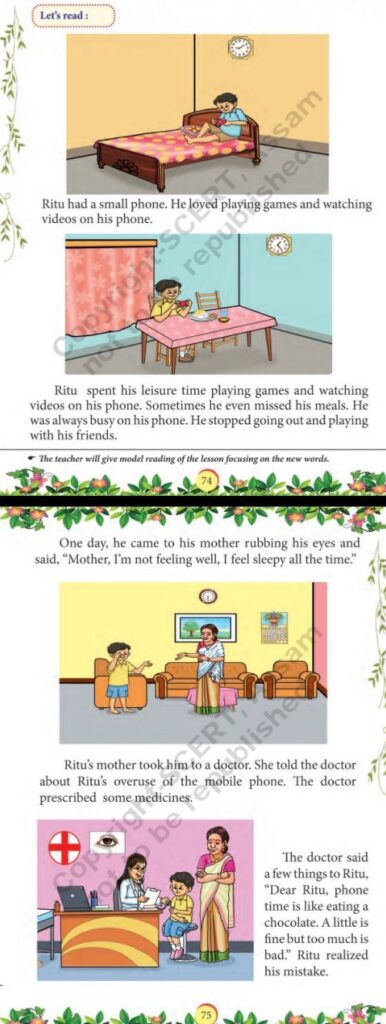
• Show the first picture where Ritu is lying on the bed with a phone.
• Ask:
– “What is the boy doing?”
– “Do you think this is good or bad?”
• Tell students:
Today we will read a story about Ritu, who used his phone too much and what happened to him.
—
Concept Building:
Teacher reads the story aloud, explaining each scene:
Story Points:
1. Ritu had a mobile phone. He loved playing games and watching videos.
2. He spent all his free time on the phone.
3. Sometimes he even missed his meals and stopped going outside.
4. One day, he felt unwell—sleepy, tired, rubbing his eyes.
5. His mother took him to the doctor.
6. The doctor said overuse of mobile phones is harmful.
7. He explained: “Phone time is like chocolate—some is fine, too much is bad.”
8. Ritu understood his mistake.
Vocabulary:
• Leisure time, overuse, prescribed, medicines, realized
Oral Questions:
1. What did Ritu love to do on his phone?
2. Why did he miss his meals?
3. How was Ritu feeling one day?
4. What did the doctor tell him?
5. What lesson did Ritu learn?
—
Consolidation and Reinforcement:
• Students summarize the story in 4–5 sentences.
• True/False activity:
1. Ritu always ate his meals on time. (False)
2. The doctor said too much phone use is bad. (True)
• Fill in the blanks:
1. Ritu spent his ______ time on his phone.
2. The doctor ______ some medicines.
3. Too much mobile phone use is ______.
• Matching activity:
– Doctor → medicine
– Ritu → mobile overuse
– Leisure time → free time
Value Education Discussion:
• Why should we limit screen time?
• What are healthier habits?
—
Practice:
• Students write 3 sentences on the topic: “Why too much mobile use is harmful.”
• Draw a happy Ritu playing outside and label it “Healthy Habit.”
• Pair activity:
– One student plays the role of Ritu,
– Another acts as the doctor advising him.
• List 5 good habits (example: playing outside, reading, helping at home).
Assessment
- Check whether students can retell the story in sequence.
- Assess understanding of key vocabulary through short oral and written questions.
- Ask students to identify two healthy alternatives to excessive phone use.
Classroom Activity
- Students sort picture cards into “Healthy Habit” and “Unhealthy Habit”.
- In pairs, students create a simple daily routine with time for study, play, rest and limited screen use.
Home Activity
Students record three healthy activities they do at home and share one change they can make to use screens more responsibly.