
Chapter 1: Crop Production and Management
Page 13 – Fill in the Blanks
Select the correct word from the following list and fill in the blanks:
float, water, crop, nutrients, preparation
(a) The same kind of plants grown and cultivated on a large scale at a place is called crop.
(b) The first step before growing crops is preparation of the soil.
(c) Damaged seeds would float on top of water.
(d) For growing a crop, sufficient sunlight and water and nutrients from the soil are essential.
Page 14 – Match the Following
Match items in column A with those in column B:
(i) Kharif crops – (e) Paddy and maize
(ii) Rabi crops – (d) Wheat, gram, pea
(iii) Chemical fertilisers – (b) Urea and super phosphate
(iv) Organic manure – (c) Animal excreta, cow dung urine and plant waste
Page 14 – Examples
Give two examples of each:
(a) Kharif crop: Paddy and Maize
(b) Rabi crop: Wheat and Gram
Page 14 – Paragraph Writing
Write a paragraph in your own words on each of the following:
(a) Preparation of soil: This is the first step in crop production. It involves turning and loosening the soil to allow roots to penetrate deep and breathe easily. Loosening also helps the growth of earthworms and microbes that add humus.
(b) Sowing: This is the process of putting seeds into the soil. Before sowing, good quality, clean, and healthy seeds are selected. Tools like traditional funnels or modern seed drills are used to ensure proper depth and distance.
(c) Weeding: This involves removing undesirable plants called weeds that grow naturally along with the crop. Weeds compete for water, nutrients, space, and light. Removal is done manually with a khurpi or by using chemicals called weedicides.
(d) Threshing: This is the process of separating grain seeds from the chaff in a harvested crop. It can be done manually or by using a machine called a ‘combine,’ which acts as both a harvester and a thresher.
Page 14 – Comparison & Explanation
How fertilisers are different from manure:
Answer.(1) Fertilisers are inorganic salts made in factories, while manure is a natural substance obtained from the decomposition of waste.
Fertilisers do not provide humus to the soil, whereas manure provides a lot of humus.
Fertilisers are very rich in nutrients like nitrogen and phosphorus, while manure is relatively less rich in these nutrients.
(2) What is irrigation? Describe two methods of irrigation which conserve water.
Answer. Irrigation is the supply of water to crops at regular intervals.
Two methods of irrigation which conserve water are:
(A)Sprinkler System: Water is sprayed on crops like rain through rotating nozzles, useful for uneven land.
(B)Drip System: Water falls drop by drop directly at the roots, preventing any wastage.
7. If wheat is sown in the kharif season, what would happen? Discuss.
Answer. Wheat is a Rabi crop grown in winter. If sown in the rainy (Kharif) season, it would likely fail due to excessive water and unsuitable temperatures.
8. Explain how soil gets affected by the continuous plantation of crops in a field.
Answer. Growing crops continuously makes the soil poor in specific nutrients because the soil does not get time to replenish its mineral content naturally.
9. What are weeds and how to control them ?
Answer: Weeds are undesirable plants in a field. They are controlled by tilling before sowing, manual removal (uprooting), or by spraying weedicides .
Page 14 – Flow Chart Order
Proper order for sugarcane crop production:
Preparation of soil
Ploughing the field
Sowing
Manuring
Irrigation
Harvesting
Sending crop to sugar factory
Page 15 – Word Puzzle
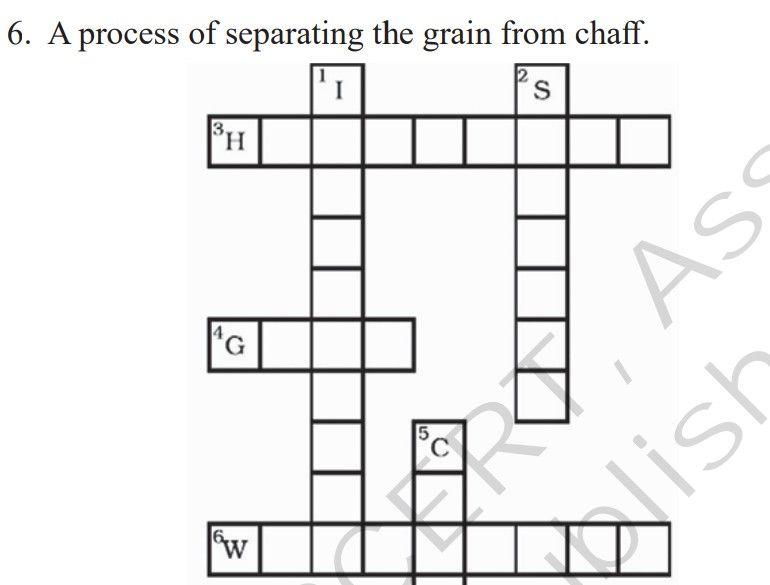 Word Puzzle Hints:
Down: 1. Irrigation; 2. Storage; 5. Crop.
Across: 3. Harvester; 4. Gram; 6. Winnowing.